Nigeria is consistently ranked among the world’s top cocoa producers, yet many of its cocoa farmers still work at subsistence level. TRACE — Traceability and Resilience in Agriculture and Cocoa Ecosystems — is a five-year programme funded by the United States Department of Agriculture aiming to change that.
Now in its fourth year, TRACE works to raise productivity in the cocoa value chain by training smallholder farmers in improved agricultural practices, strengthening buyer–seller relationships, and building a traceability system that can follow Nigerian cocoa from farm to export.
The programme, implemented by Lutheran World Relief (LWR), covers six states — Abia, Akwa Ibom, Cross River, Ekiti, Ondo and Osun — and 2,475 communities, with a target to directly reach 68,453 farmers. It is delivered through 25 implementing partners, including cocoa trading houses, exporters and sustainability organisations.
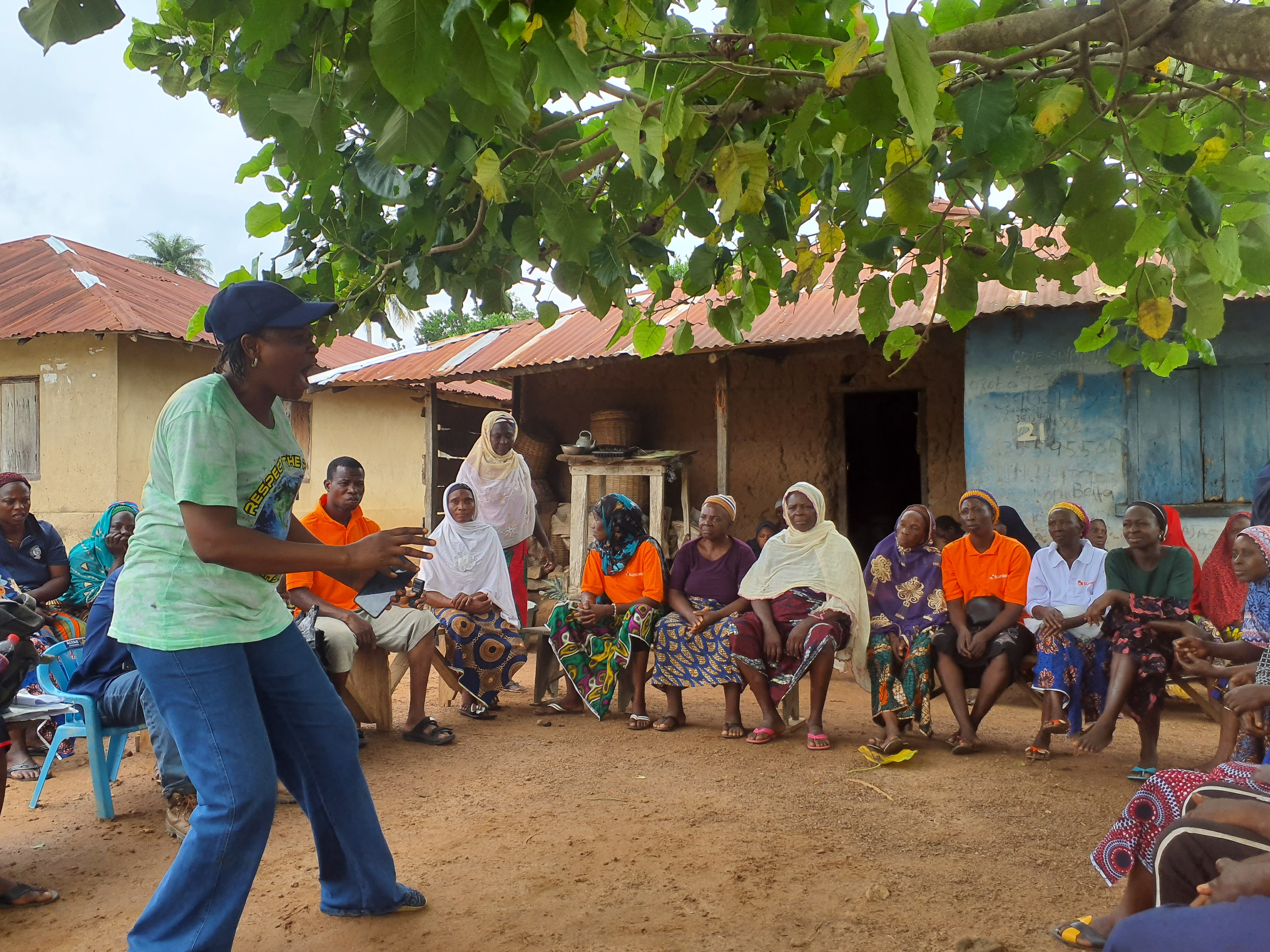
A training session with cocoa farmers in Ondo State.
The challenge
Training tens of thousands of farmers generates a large and complex flow of information: who has been trained, on what, when and where, and how much cocoa farmers are producing and selling.
The persistent challenge in international development has been how to manage and use large volumes of data effectively. It often ends up split across disconnected platforms — collected in one, stored in another, analysed in a third, and reported from a fourth — so nothing connects. Errors compound as data is copied between systems, reporting takes longer, and links between figures and the records they come from break.
On top of this, TRACE has an added complexity. Many of its 25 implementing partners are competitors, and their farmer data is commercially sensitive.
LWR wanted one data ecosystem to run the whole programme from, rather than a chain of disconnected tools. That same system also needed to provide robust data security and separation, so that each partner can only access their own farmer data.
The solution
LWR turned to its Corus International family member, CGA Technologies, and 3D.
Purpose-built for international development, 3D is designed for complex, low-connectivity and fragile operating environments. Data is collected once, online or offline, then stored, managed, analysed and reported. And because access permissions are controlled, every partner’s data can sit in the same database and only be seen by their own team.
Working closely with LWR, CGA built the configuration around the programme’s structure — its goal, objectives and indicators, the activities behind them, how data would be collected, storedand used, and each of the partners — and designed the forms. Forms were tested and revised, teams were trained, and live data collection began in February 2024.
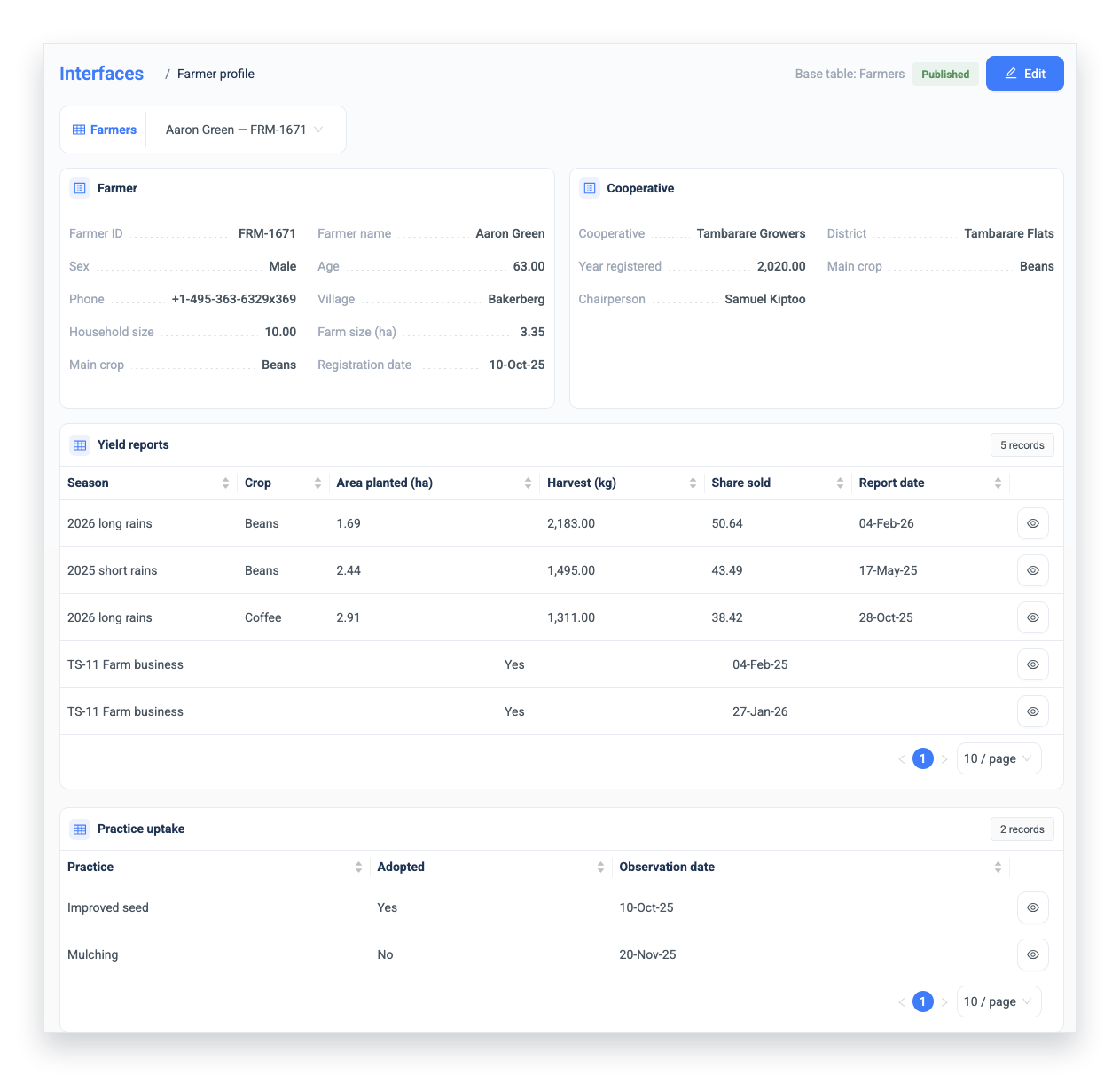
A farmer's profile in 3D, showing registration details, cooperative membership, yield reports and training records in one connected view. Demonstration data.
How it works
Every farmer in 3D is registered to a farmer group, each of which is affiliated with a specific implementing partner. Field officers who lead training activities are only affiliated with one partner and its farmer groups.
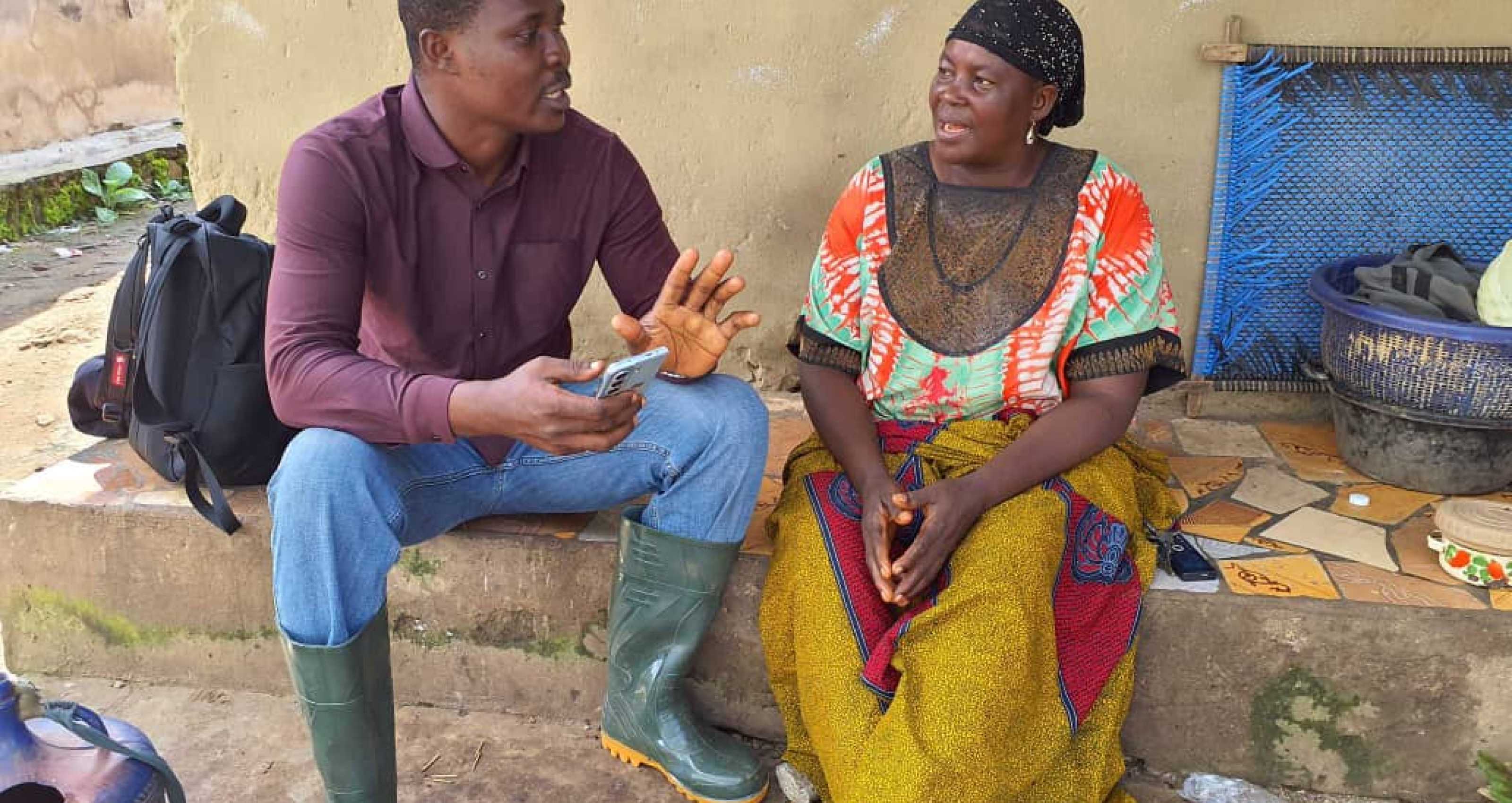
Field officers work through the 3D mobile app, downloading forms while in network coverage, collecting offline in the field and syncing when they next have a signal. The training register captures the topic, the module, the timing and the location, mostly through dropdowns and automated fields. GPS coordinates and photographs are captured together, so a reported location can be checked against where pictures were taken.
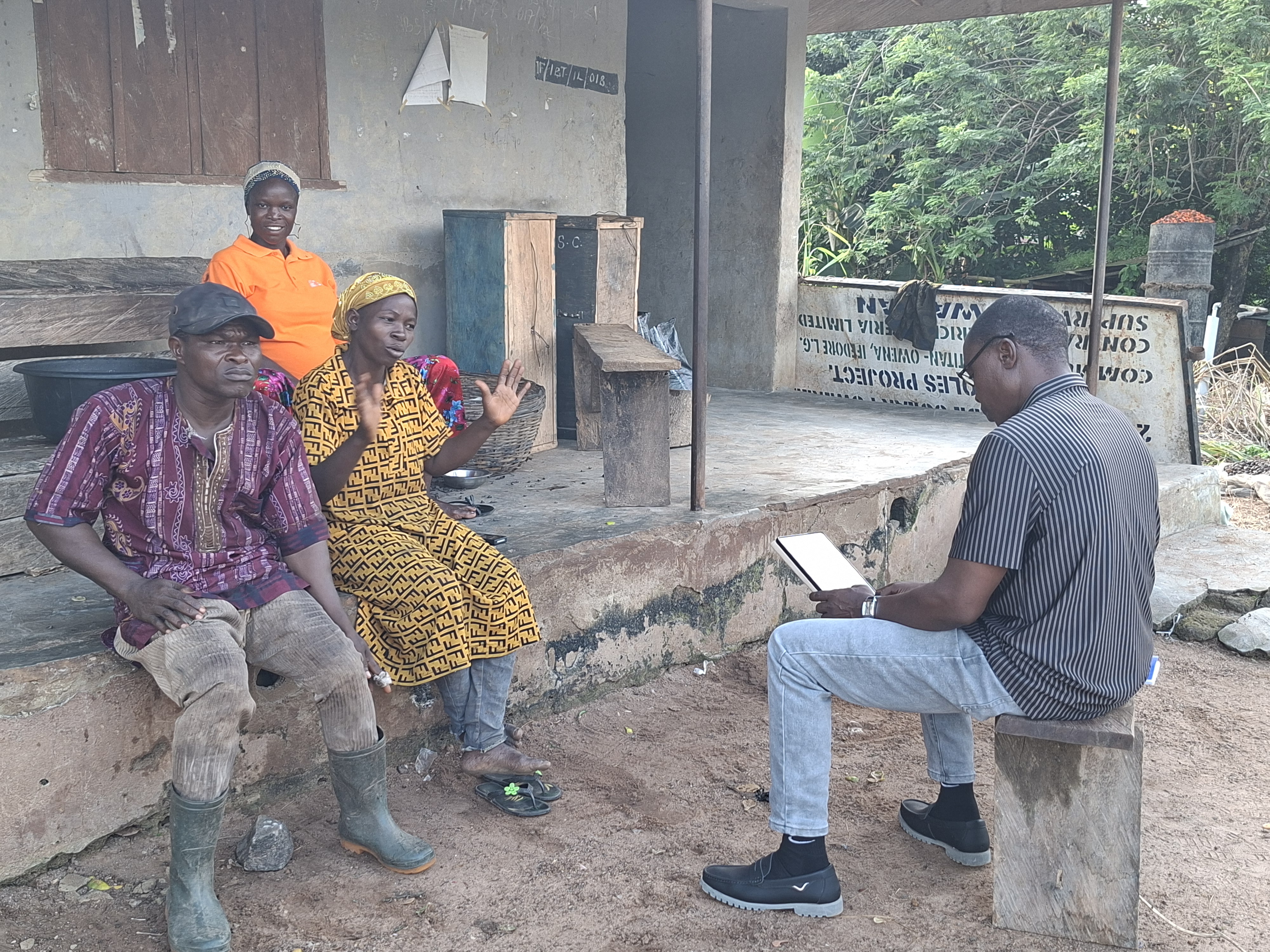
An agricultural extension officer collects semi-annual survey data in the 3D mobile app, Ondo State.
Every record entered into 3D is connected: each farmer is linked to a farmer group, to an implementing partner, and to a community within a local government area within a state. Every training session is linked back to the record of each farmer who attends, and to its module and trainer. Holding these relationships within the data rather than reconstructing them afterwards means a field officer can filter through each level to find the records they need — and TRACE can count unique farmers, follow one farmer’s training history, or show coverage by partner with one click.
What the data reveals
With 3D, the TRACE team has sight of programme activities as they happen, not months later, which changes what they can act on: gaps in coverage show up while there is time to close them, training modules can be adjusted mid-cycle, particular groups can be targeted, and the impact of a decision taken last quarter can be checked against the data now rather than at the next annual survey.
For example, analysis of 3D data showed training gaps — where farmer groups and farmers in the South West and Cross River states were yet to be reached. Effort was redirected to those areas, and farmer reach and new enrolment rose significantly from 23,000 to 40,000.
Across the programme, 113,625 farmers are now registered and 67,667 have been trained on good agricultural practices — ahead of target, with a year still to run.
3D carries far more than farmer data — including training records for intermediaries, agro-dealers and nursery operators; the village savings and loans associations; routine and quarterly field monitoring; and annual surveys, with farmer yields and sales values. Because all of it is collected in 3D there is no separate reporting exercise - reports come straight from the data. Oluwatosin estimates this has cut reporting time by at least 25%.
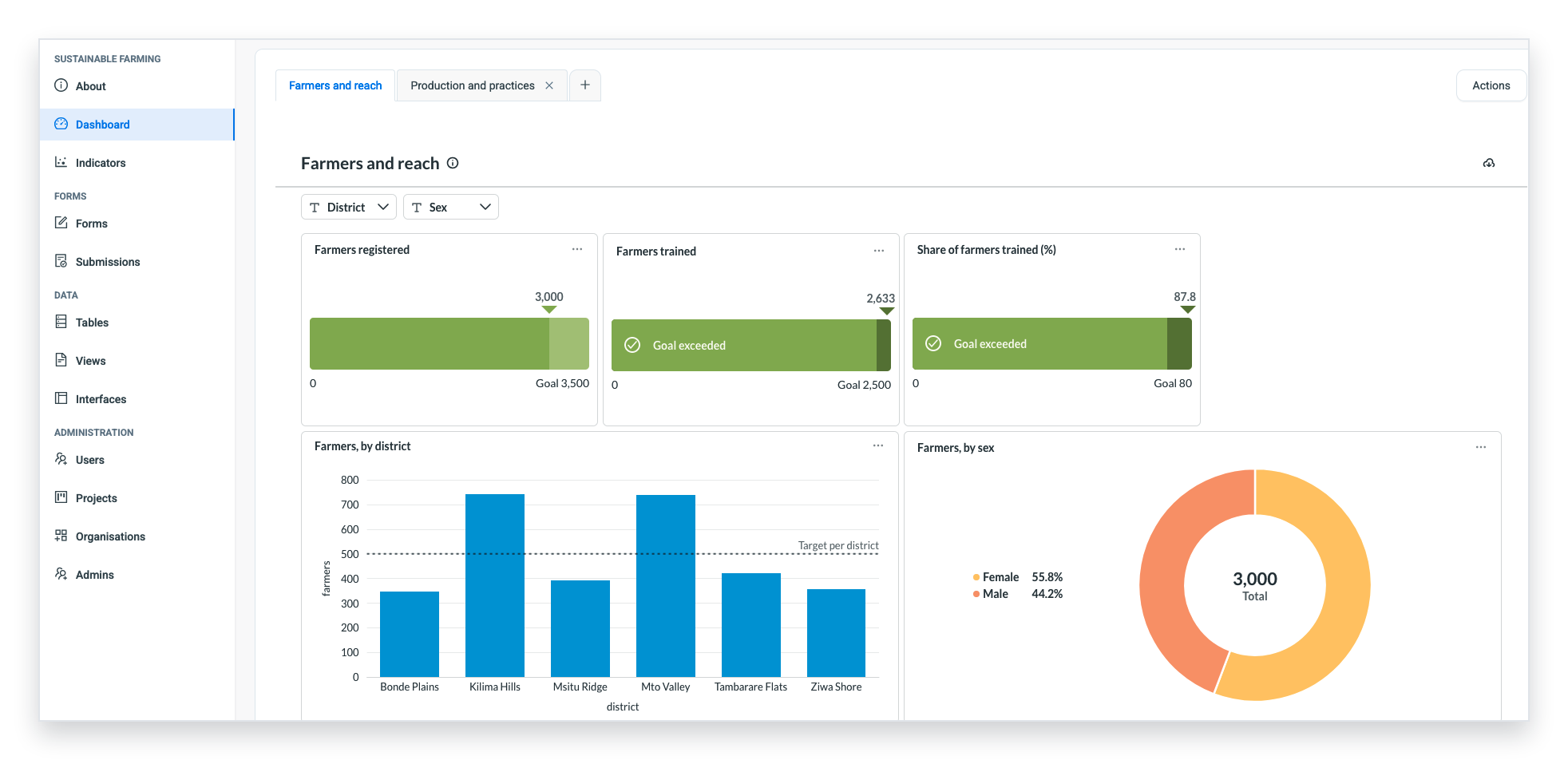
A programme dashboard in 3D, showing farmer registration and training against targets, with results by district and by sex. Demonstration data.
What comes next
3D now supports four LWR-led USDA programmes: TRACE-Nigeria, PROFIT-Togo, SAMBRIDHI-Nepal and Vietnam-Aquaculture. Because USDA standard indicators are embedded by design, each reports from the same underlying structure — a consistent, auditable record of project performance, whether the work is a single-country initiative or a large multi-partner portfolio. Real-time dashboards and in-platform analysis let data be disaggregated by geography, cohort or project component, so field staff, MEL teams and senior leadership are all working from the same live picture.
I give 3D 10 out of 10, and I would recommend it to any organisation. There are protocols to ensure that your data on 3D is safe, secure, and free from external interference or manipulation. And CGA is very responsive — if we say we want something, they look at it and, if it’s possible, integrate it into the system.
- Oluwatosin Oni, MEL Director, TRACE, LWR.
TRACE is implemented by Lutheran World Relief with CRIN, IITA and C-Lever.org, funded by the United States Department of Agriculture under Food for Progress, and runs from October 2022 to September 2027.