
In Sierra Leone, it can be hard for a girl to enrol in school. Staying there – through economic pressure, family dynamics, and the realities of life in some of the country's most under–resourced communities – is even harder.
The Girls in School Initiative (GISI), implemented and funded by Corus International, provides monthly cash transfers to vulnerable girls aimed at increasing school retention. The cash is conditional on regular attendance, helping the girls and their families cover basic needs that might otherwise keep them out of school.
Now in its third year, GISI supports more than 2,100 girls in 78 schools across five districts. By design, it is delivered by a small programme team to ensure more resources go directly to supporting girls. To make that model work at scale, the programme is built around data systems that support the operational work behind each cash transfer: monitoring attendance, following up absences, making referrals, and documenting payment decisions.
That is where 3D, our intelligent data platform for project delivery, comes in.
The challenge
Managing a conditional cash transfer programme at scale means tracking attendance, flagging absences, visiting homes and schools, recording what is found, and deciding whether to continue, suspend, or remove a payment. Across 78 schools and more than 2,100 girls, that is a significant project delivery challenge.
Without a reliable system, that process would be done on paper: district coordinators travelling by motorbike across multiple schools and homes filling in forms that can be lost or forgotten before the data is manually entered into spreadsheets and reconciled before every payment cycle. Without a clear picture of each learner's situation, the programme cannot guarantee that cash is reaching the right girls, or that the most complex cases are getting the attention they need.
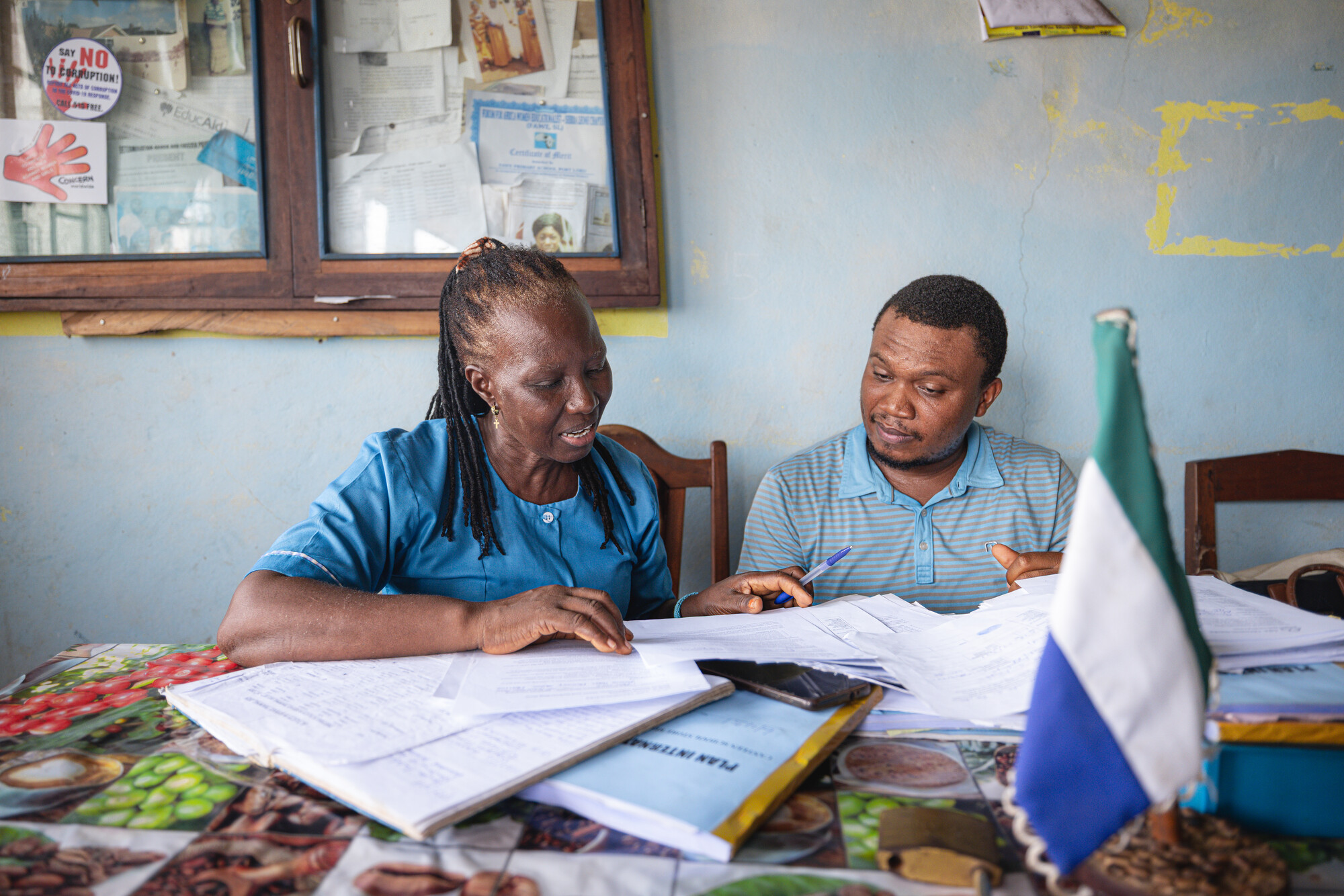
School leader, Mrs Patricia, and GISI District Coordinator, Emmanuel Sesay, review enrolment records during a visit in Port Loko.
How it works
GISI uses three CGA systems that work together to manage the programme end to end: Wi De Ya, the Sierra Leone deployment of our education system HereMIS, monitors attendance, 3D manages case follow-up, payment decisions, post–distribution monitoring, and end–of–year evaluation, and the CashTool manages payments and grievances.
At the end of each month, the programme coordinator reviews attendance data in Wi De Ya. Any learner absent for five or more days is flagged and that list is migrated into 3D, which becomes the working record for all follow–up activity.
District coordinators use the learner follow–up form in 3D to record every visit – to the school, the home, or the caregiver's place of work. The form follows a simple structure: issue, recommendation, action plan, capturing who was engaged, the method of contact and a visit summary.
Each visit is logged so a learner's full history of contact builds up over time rather than existing as separate, disconnected notes. When a payment decision is due, the programme coordinator reads back through that history in 3D and updates a case table – who has met their attendance goal, who is being suspended, who has been removed from the list.
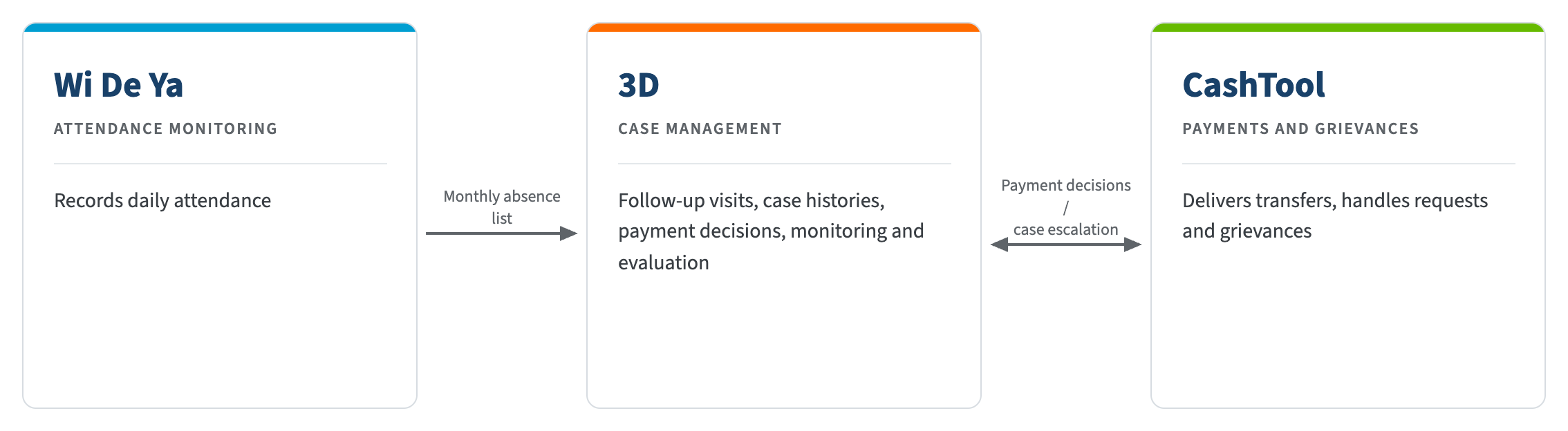
The three systems behind GISI, and how data flows between them.
What the data reveals
Follow-up visits to a learner’s home often reveal what an attendance register cannot: Some caregivers spend the cash on other household costs – medical bills, food when there is nothing else. Some hand the money straight to the child. Some never tell the learner a payment has arrived at all. One visit found a girl receiving the grant but not attending school. Another found a girl who had simply decided she no longer wanted to go; she was referred for psychosocial support and is back in school now.
Coordinators record every contact in 3D, not just the formal follow-ups, and the information revealed is becoming organisational learning. Menstrual hygiene as a barrier to attendance is one example – it went unflagged in the previous academic year and is now showing up in the records, leading the programme to pursue partnerships with wraparound support services not previously identified.
Because the coordinators record every contact they have – with caregivers, school leaders, teachers and learners – we've been able to gather much more information. Things that used to just come up in a meeting and were never written down are now in the system. It gives us a full picture of what's going on, so we can offer the right support instead of trying to piece it together from spreadsheets.
What 3D makes possible
The CashTool and 3D are connected, so a case can move between them. A caregiver asking to update a phone number is a CashTool request. Sometimes that request points to something more complicated happening at home, and the coordinator opens a case in 3D – turning what looked administrative into a proper case record and management.
In the academic year 2025/6, 56 follow–up visits were conducted for 38 learners.
What comes next
As GISI scales, 3D scales with it. Dashboards are being updated to reflect the current academic year, giving programme managers a live reporting tool alongside the case management record.
For GISI, 3D is not a reporting tool. It is GISI's operational backbone, using data to understand and respond to the lives of the girls the programme serves, and supporting Corus International to act in real time.
The Girls in School Initiative is implemented and funded by Corus International.